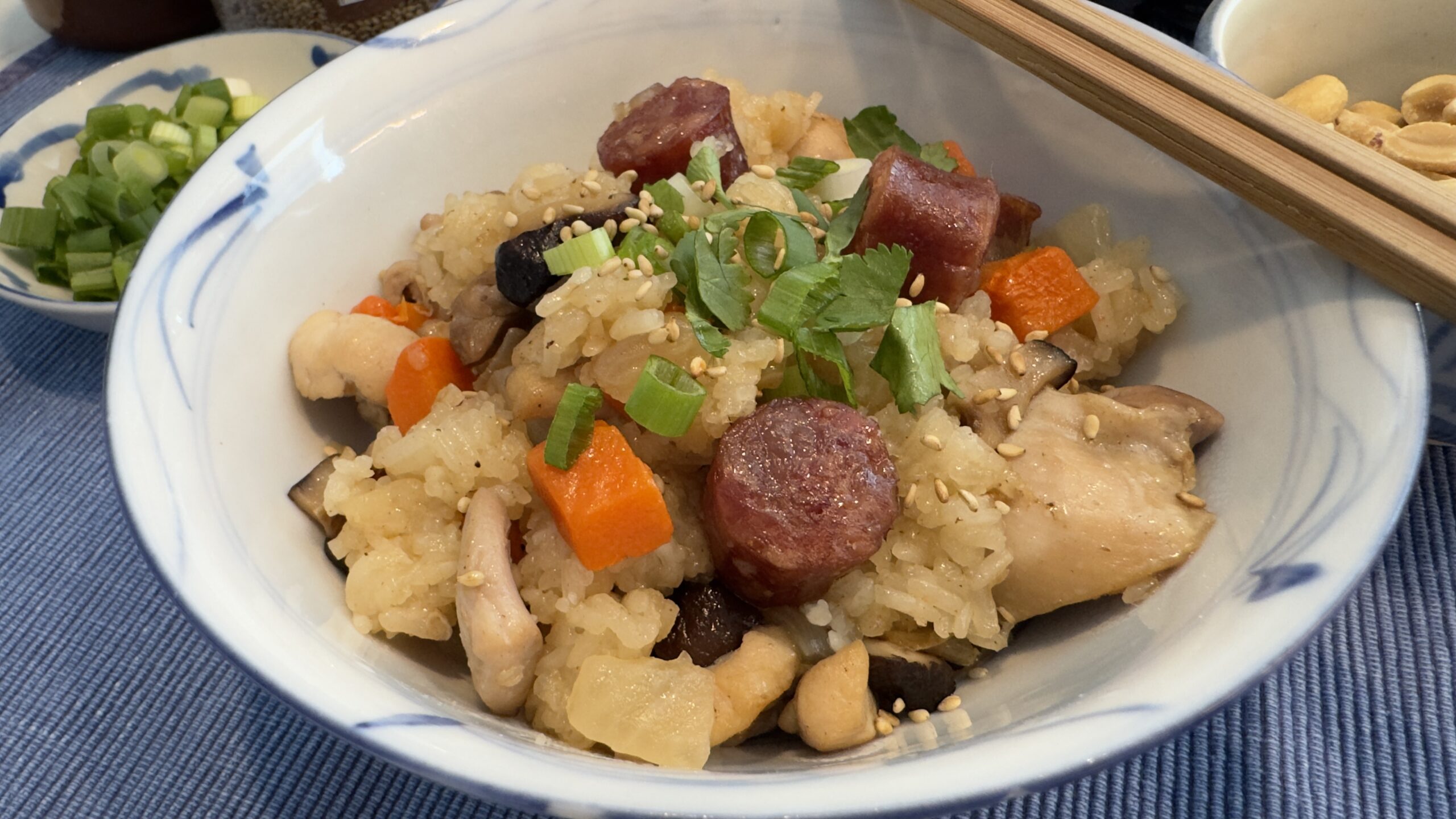
Cantonese Chicken Sticky Rice (Nor Mai Gai)
I first tried homemade sticky rice back in 1982, in Guangzhou. China had just opened its doors to America and the rest of the world. Back then people were still wearing Mao suits; they even used peat for heat and to cook.
A relative who lived in communal housing cooked Nor Mai Gai for us. She and her family shared a kitchen with other households in the building.
Nor Mai Gai, (nor mai is sticky rice and gai means chicken), a Cantonese dish, is commonly found in dimsum restaurants. It can be served in small, glass rice bowls, turned upside down, or wrapped in lotus leaf, and steamed. During Dragon Boat Festival, sticky rice is used to make traditional zong, a dumpling wrapped in bamboo leaves, and boiled.
Nor Mai Gai is a popular snack food, great for lunch, or as a side dish. In Asia, we eat it for breakfast also.
Before we start, sticky rice is not the same as regular white rice. Sticky rice is also called sweet rice, or glutinous rice. And they also come in long and short grain.
A word of warning: Cooking sticky rice can be complicated.
It really is. If you add too much water, it gets soft and gummy. If you don’t add enough water, the center of the rice grain will stay white and taste chalky. This means it’s still uncooked, and then you have to add water, and continue cooking. That sweet spot of perfect proportion is hard to gauge. (Until you’ve made a few mistakes.)
Also there are many choices of sticky rice–Thai, Korean, or American, long or short grain. (In this recipe, I use Thai sweet rice, which is long grain.)
You can boil or steam it. If you boil the rice, you can use a regular pot on a stove top, or a rice cooker, microwave, or instant pot. (In this recipe, I’m using a rice cooker.) See below for cooking in the microwave or on the stovetop.
The biggest issue for me is whether to soak or not to soak the rice. (Here, I’m doing a little bit of both.)
Our aunt told me you had to soak the rice overnight after you pick out stones that might be in the rice. Biting into stone was a common occurrence for many of our co-workers who chipped their teeth just eating rice. Needless to say, that deterred me for years and it wasn’t until I came back into the modern world of microwaving that I ventured to cook this dish.
Most blogs will also tell you to soak the rice. From at least six hours to overnight! That involves too much pre-planning for me. I’ve tried soaking the rice once for six hours and it came out gummy.
I think pre-soaking the rice works really well if you are steaming the rice. I’ve done this for Thai Mango Sticky Rice. In fact, if you steam the rice, you have to soak it.
This also means you should have a steamer, one of those double-tier steamers. I steam my Thai Sweet Rice in a stainless steel mesh strainer that sits perfectly over my three-quart pot.
Steaming works with Mango Sticky Rice because when it’s done, only sweetened coconut milk is mixed into the rice to give it that delicious flavor.
With Nor Mai Gai, you add a lot more ingredients–chicken, mushroom, Chinese sausage, carrot, and onion–doubling the volume of the food.
Cooking Nor Mai Gai in a rice cooker is the simplest, I think. The savory chicken and vegetable ingredients are fried separately in a wok and then added to the cooked rice in the rice cooker.
In this recipe, the rice is actually pre-soaked–in hot water–but this doesn’t add more time to the total cooking process because I prepare my ingredients simultaneously while the rice is soaking.
Rice to water portion
This is crucial. Here’s the rule of thumb (or knuckle). By now, almost everyone knows that Chinese people measure the amount of water to add to rice by measuring the water level of rice to one knuckle above the level of the rice. I measure this by picking a grain at the side of the pot that is about ¾ inch above the level of the rice, and fill the water till there.
Glutinous rice needs MUCH LESS water. It’s one cup rice to about three-quarters cup water. Actually, to be exact, the portions are five-sixth of a cup of water. So give it about one tablespoon more of water. ALSO, it is about ⅓ inch above the level of the rice. Sorry, I did say this was complicated. So…
1 cup rice to ¾ cup (plus 1 tablespoon) water
OR
About ⅓ inch above the level of rice.
Process for cooking Nor Mai Gai:
Rinse the rice and let it strain in a colander for a few minutes. Bring 3 or 4 cups of water to boil.
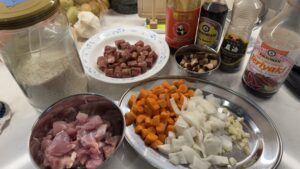
Gather ingredients: chicken, mushroom, carrot, onion and seasonings.
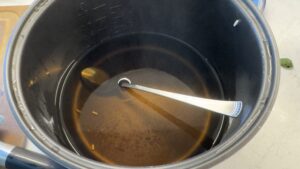
Measure the amount of hot water and place it in the rice cooker insert.
Add soy sauce and salt.
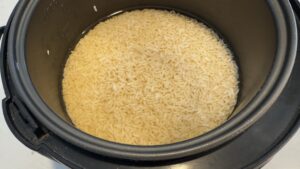
Stir and then add rice. And let it sit. Note that water is about ⅓ inch above the level of the rice. DO NOT PRESS COOK YET.
Meanwhile prepare ingredients: marinate chicken, cook mushroom and carrot in a small pot.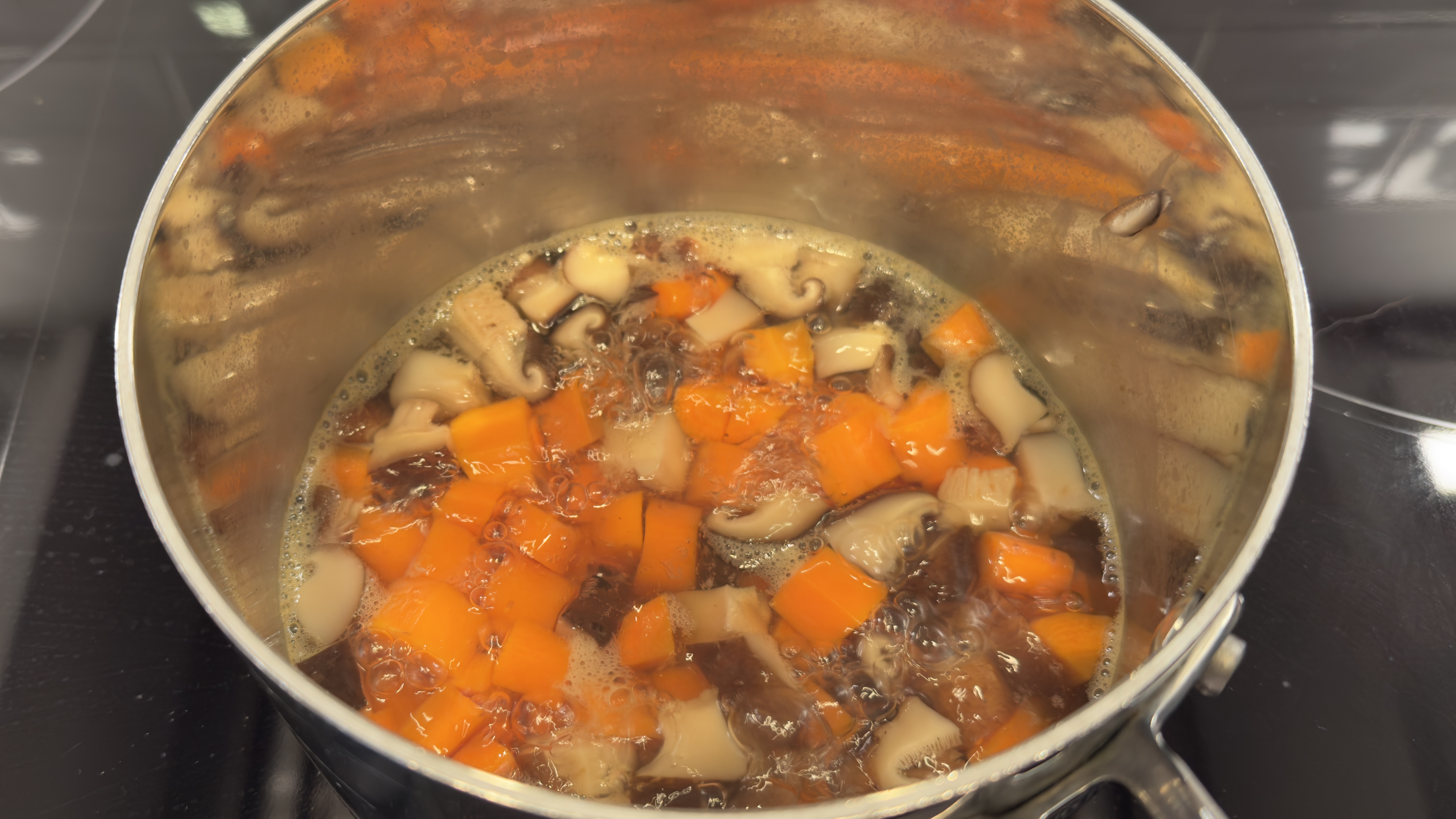
Then PRESS COOK to start cooking rice.
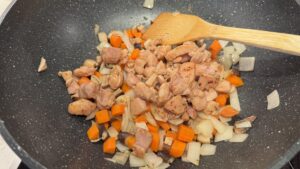
While rice is cooking, start frying the chicken and the vegetables. Both will be done about the same time.
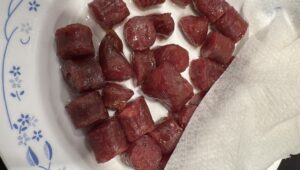
MIcrowave Chinese sausage.
When rice is cooked, check for doneness. Grain should be plump and translucent.
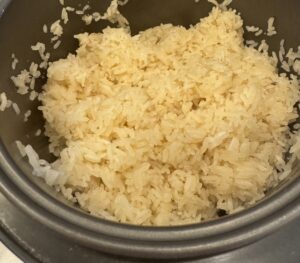
Savory ingredients are then added to the rice cooker and combined well.
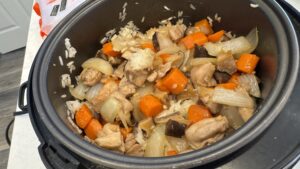
Further notes:
–Asian rice cookers come with their own measuring cup, which we call muk. Some are smaller than others. But generally one muk is about 6 ounces, or equivalent to ¾ of a regular measuring cup. This recipe uses a regular measuring cup.
–It doesn’t matter which cup you use. If you use the muk, measure the water and other ingredients with that cup.
–Like white rice, sticky rice needs to be rinsed thoroughly to clear it of its talcum. Rinse it three or four times, and then drain the water well. In this recipe, I strain it in a colander and let it sit for about 5-10 minutes while I work on setting up my ingredients.
Cooking in pot over stove top:
To cook it in a regular 3-quart saucepan over the stovetop, follow the process of straining and soaking the rice, adding the same amount of water. Bring the water to boil, leaving pot uncovered. Immediately, lower the heat and bring it to a simmer. The lower the simmer, the better. Then cover the pot and leave it (meaning don’t peep!) It should be done in 15-20 minutes. Then continue to add savory ingredients.
Cooking with microwave:
Use the same process of straining and soaking. Place water and rice in a microwaveable container. Bring to boil, uncovered, 2-3 minutes. Cover and cook on low for 10-15 minutes until water is absorbed. Then continue to add savory ingredients.
Troubleshoot:
When the rice cooker signals that the cooking is done, loosen the rice with a paddle, bringing the bottom layer of rice up. If the rice looks white inside, it is undercooked. Spray water generously over the rice, close the lid of the rice cooker and press cook again.
Here’s the Recipe
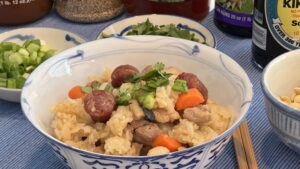
Cantonese Chicken Sticky Rice (Nor Mai Fan)
Serves 4
1½ cups sticky rice
1¼ cups, hot water
1 teaspoon salt
1 teaspoon soy sauce
2 medium-size chicken thighs, diced,( 8 oz)
1 tablespoon soy sauce
¼ tablespoon sugar (optional)
Dash of white pepper
1 cup diced carrot
3 dried Chinese mushroom, soaked and diced
1 cup diced onion
2 cloves garlic, finely chopped
2 tablespoons oil
1-2 tablespoons soy sauce
1 tablespoon oyster sauce
4 Chinese sausage, diced
In a large bowl, rinse rice carefully three or four times. Strain rice in a colander. Let sit for about 5-10 minutes. Meanwhile, gather your ingredients together.
Add hot water to the inside pot of a rice cooker. Add salt and soy sauce. Add strained rice and stir rice with water. Level out rice. Water should be ⅓ inch above the level of the rice. Let rice soak for 25-30 minutes.
While waiting for rice to soak, prepare ingredients. In a bowl, marinate chicken in soy sauce, sugar and pepper. Set aside.
In a 3-quart sauce pan, bring 2 cups of water to boil. Add diced mushroom and boil for 5 minutes. Add carrot, lower heat to medium and cook until carrot is tender. Strain ingredients and set aside.
When rice has soaked for 25-30 minutes, place insert pot in the rice cooker, press start, selecting the White Rice function.
In a large frying pan, heat half the oil. Add onion and fry for about 2 minutes until onion is softened. Lower heat to medium. Add garlic and fry for about 30 seconds, until slightly softened. Do not brown. Add chicken, raise heat to medium and fry and toss well until chicken turns color and is almost cooked, about 3-5 minutes. Add carrot, mushroom, onion, soy sauce and oyster sauce. Stir well until chicken is fully cooked. Remove pan from heat and set aside.
In a dish, place Chinese sausage. Dampen a kitchen paper towel and cover sausage. Microwave on high for 45 seconds. Remove and set aside, leaving it covered.
When the rice cooker beeps done, check if rice is perfectly done. With a rice paddle, scrape rice from the bottom to loosen. Rice should be plump and translucent throughout. If rice looks dry, spray a little water on rice, and cover to keep warm. (See below to troubleshoot.)
Add chicken and vegetables, and Chinese sausage to rice and mix well. Add seasoning sauce to taste. Leave in rice cooker for another 5-10 minutes before serving.
If rice cooker is a small size, you can transfer the rice to the wok and mix the ingredients in the wok. Return rice and chicken to rice cooker. Cover and keep warm for 10-15 minutes. Serve hot or at room temperature
Garnish with:
Peanuts
Chopped spring onion and cilantro
Hoisin sauce
Thai Sweet Chilli Sauce
Sriracha
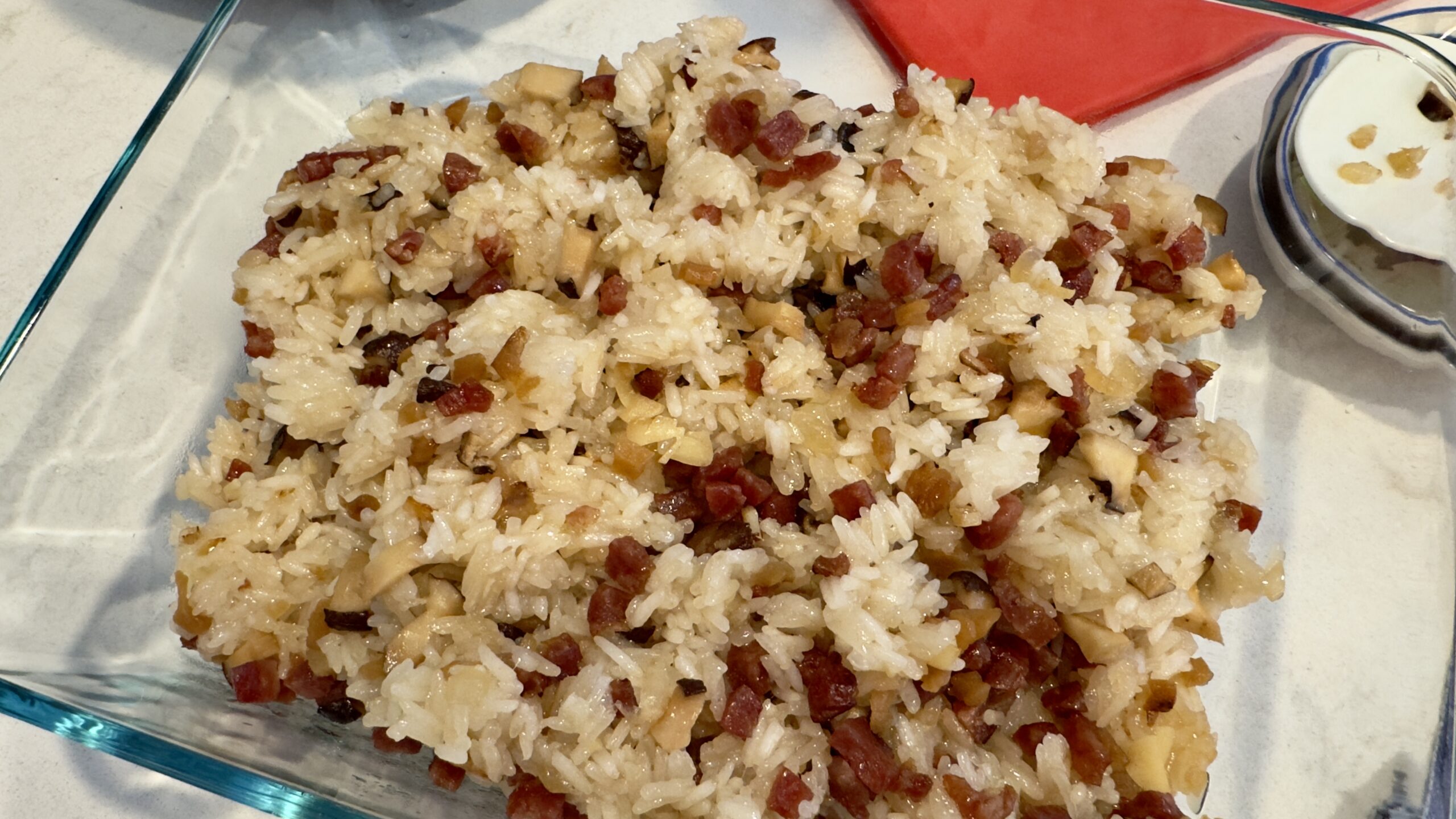

[…] Prepare the rice, following the recipe on Cantonese Sticky Rice with Chicken. https://paninpanout.org/cantonese-chicken-sticky-rice-nor-mai-gai […]